

THE REWIRE
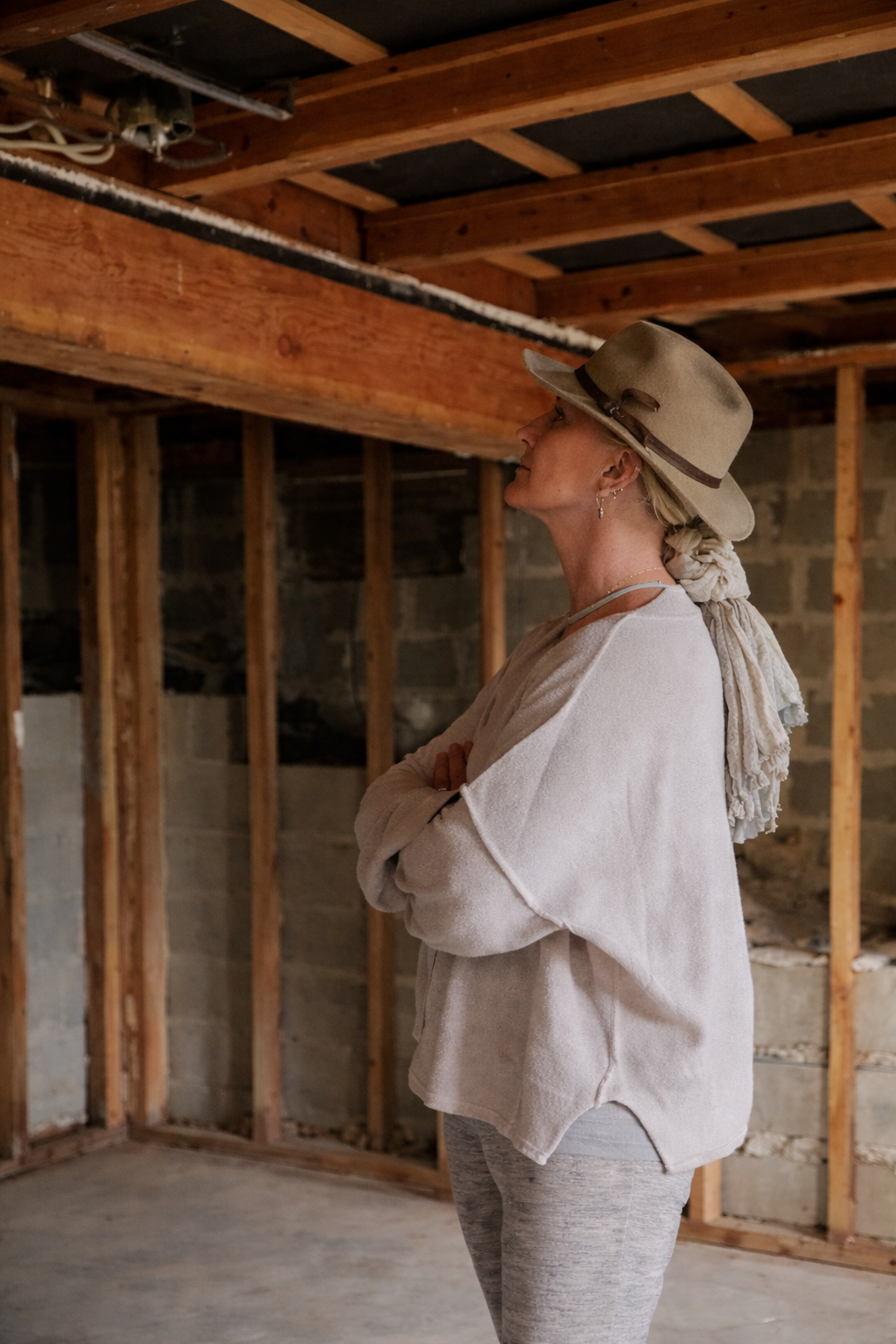
The imagination makes up stories to fill in the blanks.
____________________________
We would perpetually buy the homes that others avoided.
The ones with an abundance of evidence of neglect and decay.
Like little pack rats, the two of us
[then three, add another, and finally five of us]
gathered ourselves and our belongings into one room and then the other,
making nests of futons and pillows
just warm and comfortable enough
to endure the construction ahead.
It was the unknown as much as the obvious that compelled us.
Over twenty-three homes we honed the superpower of seeing through walls.
Like a parlor game we would assert with authority what we knew to expect
before crowbars and hammers began to rip and tear.
Yesterday, Cameron [the middle son] and I sat at the corner table bathed
in the tiniest sliver of Idaho winter light and we bragged to one another a bit
about our conquests over drywall and the real and present need
for self-reliance in our lives.
We, this packrat family, are mostly undaunted
when the unexpected thing comes knocking.
Cancer, being the most of these.
If I could give you one tasty sliver of advice,
it would be this:
REWIRE YOURSELF TO FEEL SAFE IN THE UNKNOWN.
In years most curious and recent,
that drywall has redefined itself as skin—
my body on the outside, appearing normal,
on the inside in desperate need of repair.
There was something else at work in those houses.
Not recklessness.
Not bravado.
A irresistible pull.
A way the unknown didn’t register as threat but as threshold.
We didn’t enter those homes because we were fearless.
We entered them because something in us recognized them.
Because the unfinished was a language we spoke.
Because the walls, already opened by neglect,
were vulnerable to their core.
Wonder has a gravity to it.
It doesn’t rush.
It doesn’t warn.
It doesn’t promise safety in advance.
It simply draws you closer
and asks if you’re willing to see.
The unknown, for us, was never empty.
It was thick with evidence—
layers of former lives, former structures, former intentions—
all waiting to be touched again:
This could be something.
This could become.
And yes, the work was hard.
Dust everywhere.
The long middle where nothing looked better…yet.
The patience required to live inside disruption
without demanding it hurry.
But difficulty was not the same as danger.
And unfamiliar was not the same as unsafe.
We trusted the work
because we trusted ourselves in the work.
Our hands learned first.
Our bodies followed.
Day after day of immersion
taught us something no blueprint ever could:
that safety is not the absence of exposure,
that you can remain exposed and still belong to yourself.
Safety, it turns out, was built from repetition.
From immersion.
From discovering [again and again]
that you can be inside the unfamiliar
without abandoning who you are.
That line is not poetic license.
It is lived truth.
Confidence doesn’t come from the outcome.
It comes from recognizing your own hands in the work.
From remembering how you steady yourself
when the ground is uneven.
How you discern what must come down
and what can be saved.
How you learn, slowly,
to trust your capacity to endure the middle.
Over time, the unknown stops being something you brace against.
It becomes a place you know how to enter.
A place you expect to be changed by.
This is how the unknown becomes sanctified—
not because it is gentle,
but because it is honest.
It makes room for the whole of you.
The competent and the confused.
The builder and the beginner.
The part that knows
and the part that is still learning how to see.
And then—without spectacle—
the teacher changes locations.
Skin becomes wall.
Interior opens.
The same invitation repeats itself
at a deeper register.
Not as punishment.
Not as threat.
But as continuation.
Full renovation has always required full entry.
And the life you crave cannot be built from the outside looking in.
The unknown is not standing in the way of your becoming.
It is the only place vast enough to hold all of who you are.
NOTES: A Confession
I need to say this plainly.
It took the entire writing of this piece
to understand what I was actually trying to say.
I thought I was writing about learning how to feel safe in the unknown.
But what revealed itself—slowly and insistently—
was something else entirely.
Safety didn’t come from managing the unknown.
It came from redefining it.
I couldn’t arrive at that understanding through clarity alone.
I had to stay in the uncertainty of the writing itself—
circling, revising, undoing, beginning again—
long enough for the definition to change.
This piece asked the same thing of me
that it asks of you:
To resist premature conclusions.
To stay with the discomfort of not quite knowing.
To trust that immersion teaches
what insight cannot.
The unknown, in the end,
did not need to be made safe.
It needed to be entered earnestly.
The safety I was looking for
was not waiting on the other side of certainty.
It emerged in the willingness
to remain present
while the meaning was still unfinished, unrevealed.
That is the rewire.
And if this piece carries any authority at all,
it’s not because I mastered the idea—
it’s because I was mastered by the process.
Image: I’m bald in this photo, under that scarf and hat. We were in the middle of a home renovation, and I was in the middle of chemotherapy, and nothing in my life looked finished yet. I didn’t know it then, but this was already the work I would later write about — learning how to stay present inside what is unfinished, unprotected, and still becoming.