

THE ART OF ITERATION
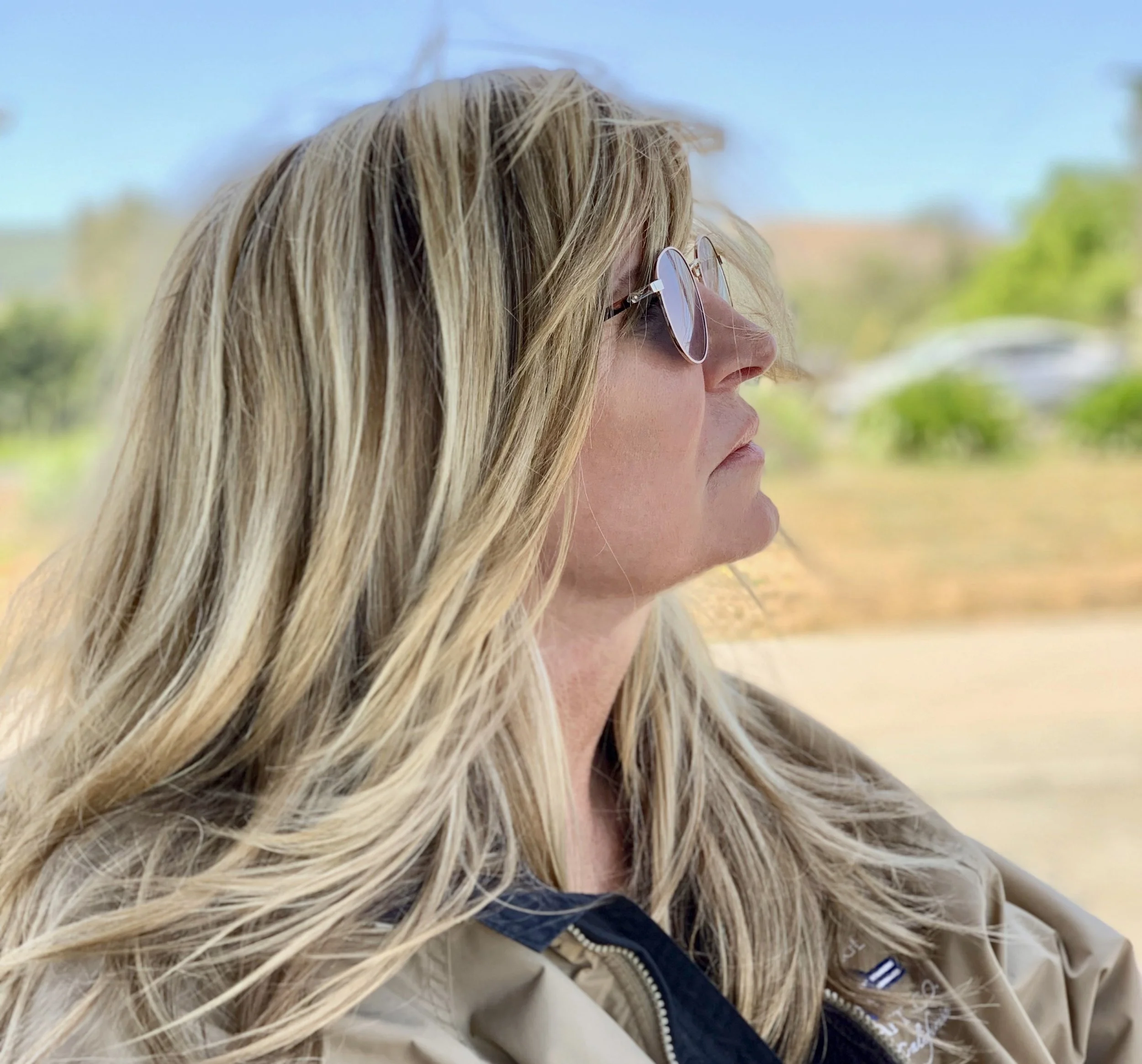
Until recently, I viewed her as someone I “used” to be.
____________________________
This woman. You can almost see her hair blowing in the breeze. She marks an important moment of my history. Still, I perceived her as old, stale, irrelevant in context of the recent life that has, in so many ways, marked me.
My tribe of cancer warriors, sometimes including myself, is inclined to define themselves within the context of this all-consuming disease. I have wondered if it’s a way of coping, taking charge, or maybe even discovering a deeper sense of purpose by walking others through a healing journey that might be their own, now or someday.
Cancer [or any life-altering situation] brings with it a perspective of life and loss that enlightens in so many character-building ways. But the perspective also narrows—so that we come to identify ourselves within the circumstance to the detriment of nurturing and undergirding the complexity of ourselves.
Prior to cancer, this woman existed for sixty-one years, six decades that formed an identity outside the one she is currently living in. And yet, right up until this moment, I believed I had left this version of me in my past.
But she—this forward gazing woman
is far too embedded to ever be dismissed.
I chose this image over others because it was captured by Ron, without my awareness. In fact, my mind was on something else entirely—That is, I was psyching myself up to climb into an open-cockpit biplane for a fortieth anniversary surprise.
If you asked me, I would tell you she looks regal, even though she is [somewhat] terrified.
This quality, above nearly every other, has been the one that has carried me through the great and difficult adventures of my life.
After much self-examination, here is what I am left with:
This woman is not “before.”
She is a different expression of the same soul.
Posting her gives me [and you] permission to exist as more than one chapter—even one very bold and compelling chapter like cancer that appears to override everything else.
Both pre and post cancer images are reflections of the same courage.
My story is so much more than the current and prevailing truth that I simply survived.
Nothing I have been is disposable.
The conversation isn’t only, “I went through something.”
The telling is permeated with the reality that “I am still me.”
My work is and always has been about staying [rooted in yourself] no matter where life leads.
This image is a powerful reminder of
what I stayed with.
That keeping of personhood is not irrelevant.
It is sacred work—
You don’t have to erase who you were to honor who you are.
Life is a layering. Not a rupture. Not a break.
If we are wise we learn the art of iteration—
It teaches that change does not mean disappearance.
Evolving does not mean abandoning yourself.
It celebrates the interior revelation,
“I am not a new person. I am a deeper one.”
There’s always a quiet grief when we change. Not the grief of what was taken, but the loss of who we were once—
The woman I was before illness.
Before everything rearranged itself.
I don’t look like her anymore.
For a long time, I thought that meant she was gone.
But she isn’t. She’s still here — in the way I look toward the horizon, in the way I let the wind touch my face,
in the way I still lean forward into whatever comes next, even when I’m afraid. Strong. Present. Moving forward anyway.
Maybe this is what becoming actually looks like.
And maybe who we were—before loss, and grief—is not something that competes with who we are
but completes our story in unexpected yet breathtaking ways.
NOTES — The Art of Iteration
In business, I used to say, “Let’s iterate this!”
Meaning?—
We didn’t have to build the perfect thing all at once.
We created the best version we could envision at the time.
And we allowed it to live in the real world, somewhat unfinished.
We listened and watched what it was capable of becoming.
And then we built from there — better, informed, more honest, more refined.
It’s never been about perfection.
It’s about learning from what life throws at us.
Human beings change the same way.
We don’t transform in clean, elegant leaps.
We live a version of ourselves.
We feel what it costs us.
We sense where we tighten and where we open.
And then, quietly, we adjust.
The feedback isn’t numbers or data.
It’s the body.
The nervous system.
The subtle knowing of what feels like alignment and what feels wrong.
We keep what gives us life.
We release what no longer fits.
How many iterations of who you were and still are have you unnecessarily discarded because of a feeling of shame, irrelevance, disappointment, disenchantment, grief?
We don’t abandon the past — we integrate it.
That is the art of iteration we can celebrate.
Cancer did not create a new woman.
It revealed a deeper draft of the same one.
Loss does not erase who we were.
It teaches us what still matters.
And equips us to allow it to shift us for good.
Becoming isn’t replacement.
It’s revision.
And the truest kind is always done with tenderness.
Practicing the Art of Iteration
If you have been through something — illness, loss, rupture, reinvention — it can be tempting to leave entire versions of yourself behind.
Iteration offers another way.
Not by returning to who you were,
but by carrying forward what was always true.
Here is what practicing the art of iteration can look like in your life:
• Notice what has stayed.
Ask yourself: What qualities have followed me through every hard season?
Courage. Humor. Sensitivity. Tenacity. Curiosity.
These are not situational. They are yours.
• Separate change from disappearance.
You may not live the same life, wear the same clothes, or hold the same roles — but ask: What about me still recognizes itself?
That recognition is continuity.
• Let the body give feedback.
Instead of asking, Is this working? ask, Does this feel like me?
Your nervous system knows when you are abandoning yourself — and when you are coming home.
• Integrate, don’t erase.
You don’t need to deny who you were to honor who you are now.
Iteration is the practice of letting former versions inform the present, not compete with it.
• Develop what feels alive.
Ask: Which parts of me want more room now?
Kindness. Boundaries. Creativity. Rest. Honesty.
Iteration is choosing to strengthen what brings aliveness, not what earns approval.
• Bring more of yourself into relationship.
Consider how your relationships might shift if you practiced staying open instead of armoring up.
What becomes possible when you let people see not just your strength, but your interior life?
• Allow grief without self-erasure.
There is often grief in becoming — not for what was taken, but for who you used to be.
Let that grief exist without interpreting it as failure or regression.
• Ask a different question of the future.
Instead of Who do I need to become?
Try: Who am I willing to stay with?
That is the art of iteration.
Not starting over.
But continuing — with more truth, more tenderness, and more of yourself intact.
Image: This was me, captured without my knowing.
My attention was turned toward something beyond the frame — not posing, not performing, simply orienting myself toward what was coming next.