

THRESHOLD
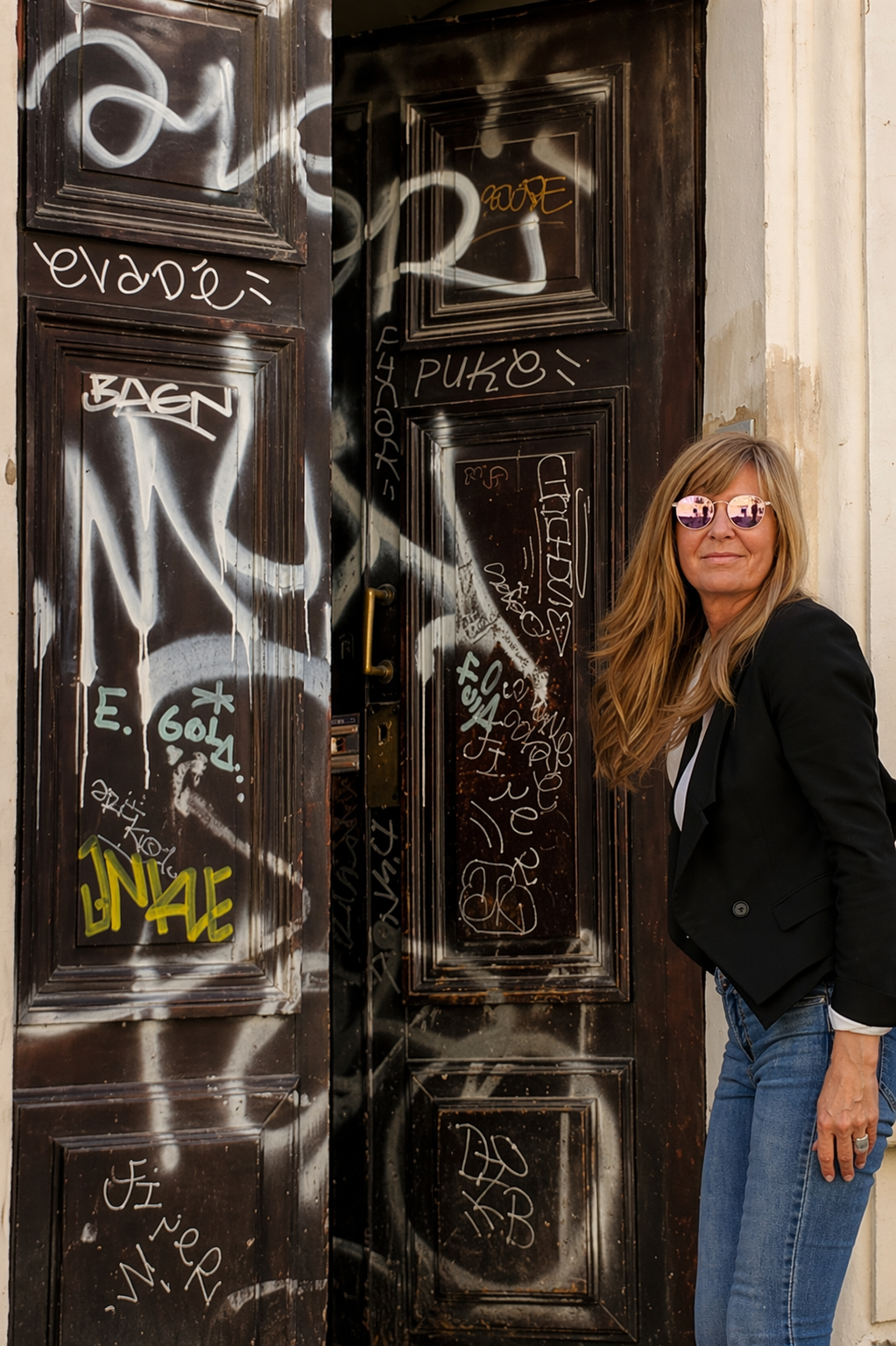
Just one little sign, I asked. One small indication that I’m supposed to be here.
Prelude: I have written about doors, taken pictures of them wherever I am. This obsession—an ever-present tension of wondering which ones are intended for me. ____________________________
The parking lot is full. Not almost. But completely.
I take this as an immediate confirmation that what I feel—uneasiness—is there for good reason. This is when I decide to bolt.
“What’s the matter with you?” my body whispered. It’s not like you to run.
But I am more than a little fatigued—body, mind, and soul.
There was a time I would knock down doors that were closed.
My mission was to accomplish what I had set out to do—
No hesitation. No questions asked.
Despite the obstacles, I always found a way.
This was me. And I was proud of it.
Giving up was never an option. It never entered my mind.
I simply and completely believed that whether something happened or didn’t happen depended entirely upon how much of myself I was willing to give.
But I have good reason to believe that pushing doors takes its toll.
On the body.
On the confidence in what is or isn’t intended.
On the ability to discern what is my idea, and what is His.
Until it quietly rewires identity around effort instead of alignment.
Just as I am about to leave, I notice a spot near the entrance.
Reluctantly, I pull in.
Still not convinced I should be here, I am ushered back into the crowded room. Seats, like parking stalls, are in short supply. I tell my nurse with equal measure of disappointment and relief, “There’s no space for me today,” my spirit like a dog on a leash, pulling frantically away.
But she gently guides me through this sea of infusions and points me to my favorite chair.
Saved. Waiting. Encouraging me to remain.
And then I notice something ‘extra’ in this divinely appointed moment:
Sticky notes adhered to the leather recliner —handwritten, loving words of encouragement from my nurses, anticipating what I am about to endure.
There were days, too many to recount, of pushing open doors never meant for me to enter.
There were years of insisting I have my way.
Do you know that not everything is meant to be opened by force?
Those seasons—of defining what was “meant to be” according to what I could accomplish in my own strength—have given way to something else entirely.
The difference between forcing access
and the recognition of being invited in.
The woman I am, now, has redefined strength as something other than determination—
She restrains the instinct to push,
and waits on no or yes.
She is honoring an agreement to what is
instead of exhausting herself trying to create what is not.
Not every closed door is meant to be opened.
And not every obstacle is an invitation to push harder still.
Some thresholds are there to inspire a better question:
Is this mine to enter?
There is a different kind of strength now.
Not built on proving, but perceiving.
Not in forcing entry,
but in recognizing where space has already been made.
This is the difference between forcing
and recognizing invitation.
It holds.
It makes space.
It waits.
Like a parking space near the entrance when there was none.
Like a chair I didn’t think would exist.
Like words written in advance for a moment I had not yet lived.
I used to believe that what was meant for me would yield to my effort.
Now I am learning something else entirely:
True strength is knowing the difference.
What is meant for me does not need to be forced open.
It is already making room.
NOTES — Reflections on Thresholds in our lives
There was a time when effort felt like the most reliable form of strength.
If something didn’t open, we tried harder.
If something resisted, we pushed through.
Sometimes, that worked.
But over time, something quieter begins to surface:
Not every closed door is meant to be opened.
And not every obstacle is asking for more from you.
There is a difference between effort and alignment
that cannot be understood conceptually.
It has to be lived.
Felt in the body.
Recognized in the moment
when something in you hesitates—
not out of fear, but out of knowing.
We often assume that resistance means we are meant to push.
But sometimes, it is asking a different question:
Is this mine to enter?
This is where discernment begins.
Not in deciding what you are capable of forcing,
but in noticing where you are no longer being asked to.
Reflections
Was there a time you pushed your way into something—only to realize it wasn’t yours?
Where in your life are you still equating effort with alignment?
Can you remember a moment when something opened for you without force? What was different?
What does your body do when something isn’t meant for you?
Do you listen?Where might you be overriding yourself in order to make something work?
What would it look like to pause at the threshold—not in hesitation, but in discernment?
Is there a door in front of you right now that is asking to be opened or simply recognized?
Image: This is me in the ancient City of Marseille. I spent my days enraptured with the architecture. Mostly, the doors. This one was cracked open, inviting me in. The space beyond is never predictable, even when we think we know what to expect. And sometimes the effort put forward to push that door open, is more costly than we imagine. I am in a new season. The doors I enter are less creative and more clinical in their design. But I always manage to see the poetry in what lies beyond. And I am more discerning about what space is inviting me in.