

SAVE YOUR BREATH
There is a difference between having words
and choosing them.
____________________________
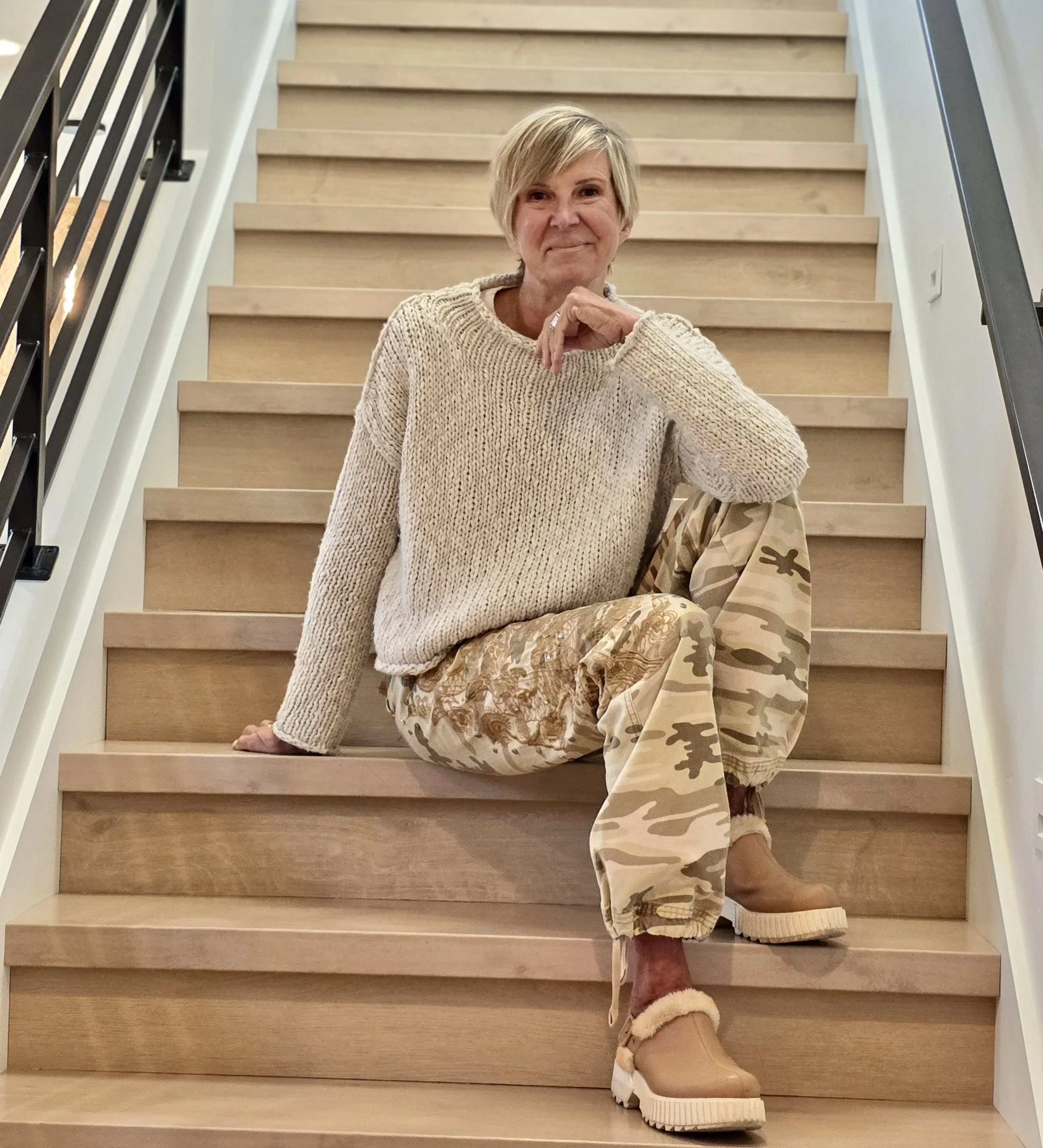
At the top of the stairs, I stop to catch my breath.
Every time.
This is the casualty of defending my body against rogue cells.
But with every loss comes a gain I hadn’t expected or couldn’t have guessed.
My words. They don’t come as freely as they used to.
Don’t get me wrong, they are considered. But the more than one hundred muscles it requires to utter a sound are conserving themselves. It follows—so are the words.
It’s a good thing, really. This holding words close.
Not everyone is entitled to them. Including myself. Those things most valuable must be protected—
Words. Thoughts. People. Love.
It used to be words were always available.
But that isn’t true. At least not anymore.
Perhaps in the mind. But in the body—not so much.
I have this deep understanding, now, that what sustains me
is not unlimited. Not even the words.
There are moments now when I feel the cost of expression before anything is said.
A tightening.
A gathering.
Something in me deciding
what can be given.
And for the first time, I am not trying to override that.
I am listening.
And obeying.
Which isn’t easy.
The world does not move this way.
It asks for more—
More words.
More opinions.
More presence.
More response.
The world rewards immediacy.
And mistakes volume for substance.
But the body does not agree.
Breath is not infinite.
And once you know that—
not as an idea, but as a lived reality—
you begin to see differently. Exist differently.
Not everything deserves your breath.
I am learning that choosing words is an act of stewardship—
not silence, or avoidance.
But placement.
And timing.
The willingness to let something remain unspoken
until it is ready to be carried well.
Because words do not disappear once spoken.
They land.
In the body.
In memory.
They shape something.
I do not want to spend my breath carelessly.
Not anymore.
Bringing beauty into another person’s life
is not only in what we do.
It is in what we say.
And just as importantly—
what we don’t.
There are words that come quickly.
And there are words
that must be waited for.
Held long enough
for the body to agree.
And when they come—
they do not scatter.
They land.
Cleanly.
With weight.
I am learning—
To say less.
But mean it more.
To trust
that what is held back
is not lost.
Only reserved.
And that is power in a world that keeps asking for more.
There is something profoundly different
about a life that answers—
with intention.
with care.
with breath.
Something that moves things.
Not with more.
But less.
NOTES
There is nothing casual about speech.
It may feel immediate.
But the body tells a different story.
Before a word is spoken, the body prepares.
Breath is drawn from the lungs.
The diaphragm lowers.
The ribs widen.
Air is not simply released—it is controlled.
More than one hundred muscles coordinate across the chest, throat, and face to produce a single sentence.
The vocal folds close and vibrate.
The tongue shapes meaning.
The jaw releases.
The lips form the edge of a thought.
All of this—
to let something leave the body.
Speech is not separate from the one who speaks.
It is carried on breath.
Formed through muscle.
Released with force that can be felt.
Which is why words land the way they do.
Not only in the mind—
but in the body.
When the system is not aligned, the body knows.
The throat tightens.
Breath shortens.
Words hesitate.
Something in the body recognizes
that what is about to be said
is not yet supported with the heart.
Perhaps this is why certain words feel different when spoken aloud.
“I’m sorry.”
“I love you.”
“I’m afraid.”
“Stay.”
They do not simply pass through the air.
They arrive. And if this is true—
then speaking is not only expression.
It is participation.
In shaping what exists between us.
Reflections on Words
The body does not treat speech casually.
When have you?
When can you remember saying something
before your body was ready to carry it?
What was the cost?
When have you used words
to release pressure instead of to place truth?
When have you withheld words
that your body had already prepared to speak?
What did it feel like to carry them?
What is the difference, in your body,
between a word that is well-timed
and one that is not?
What words have stayed with you—
not because they were repeated,
but because they were placed well?
Where are you being asked to speak
with less words, more care?
What are you carrying right now
that is waiting to be said?
The Word became flesh and made his dwelling among us.
—John 1:1,14