

THE ENCOUNTER
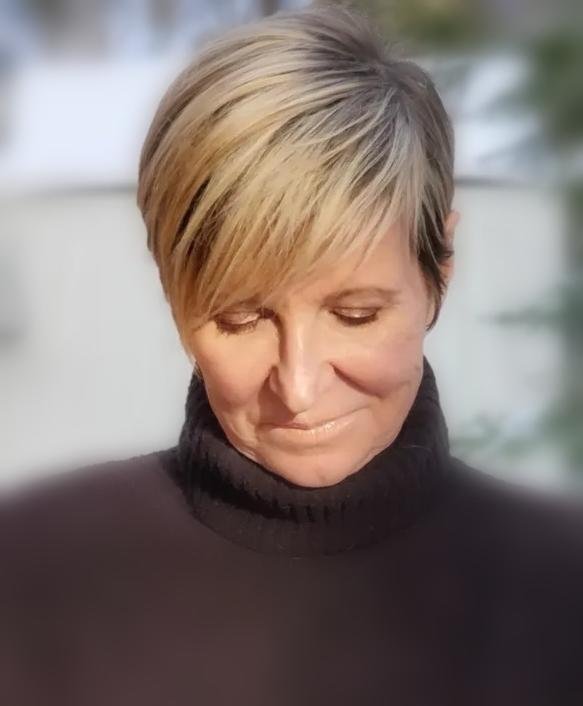
Sometimes the posture of the body reveals what the heart has been trying to say.
____________________________
Through all these years I have laid my head upon the pillow and begun my monologue in the dark.
Before bed, there are multiple little rituals intended to lull the cancer into remission and me to rest. After what seems like hours, I am tucked in comfortably, wedged between two feline bodyguards, Jack and Steve.
Then begins my nightly sacred signoff—night shadows enveloping gratefulness and pleadings that fold into the world of in-between.
In all these years of conferring with Heaven, I have never received overt objection to my chosen posture of head-to-pillow, not knees-to-floor.
But tonight, as thoughts begin to wander to places bathed in the exhaustion of my need, I hear an inner voice, jarring and “Other.” Not a soft suggestion or request but overt demand,
Get on your knees.
I am laughing now as I share my answer that immediately fell out—
You do know I have cancer?
The prompting comes again, perhaps precisely because of my circumstance I had just pointed out.
And I find myself shoving over bodyguards not easily raised.
In this emphatic moment [Him, not me] I determine to make the effort count, asserting that if we are to do this, it will be less like posturing and more like Psalm.
I am not the stranger to kneeling that I have led you to believe.
But this night, the ramblings of a wild heart were a harnessed, directed power.
There’s so much to be said of submission, honor, reverence.
But there’s so much more to it when we align the body with the mind.
Maybe this is instruction from the One who knows precisely how humans work.
Because the human brain does not think in isolation.
My body is also required.
I began to notice something curious—
When I lie down, my thinking expands in every direction.
Thoughts loop. Memories wander. Possibilities multiply. Anxiety and imagination become uninvited bedfellows I can’t control.
Lying down tends to expand internal narrative space.
That sounds like a good thing… until it isn’t.
Especially when the goal is clarity rather than chaos.
Kneeling is different—
It is what I can only describe as effortful stillness.
I feel my spine rise and my body steady.
Even my breathing slows.
And then my mind follows in a calm alertness that is welcome and rare.
Not sleepiness.
Not emotional flooding.
Something quieter but very much alive.
The noise of snoring cats falls away and in the space left behind, clarity appears. Radiant clarity.
As if the mind had opened a window and the air had finally changed.
Kneeling sent a very different signal than the lying down kind. My body became both humble and alert. But not in an anxious way.
Everything stressful quieted, even though I was there to share hard things. This is the surprising answer to a prayer request I hadn’t even shared.
Kneeling brought me into alignment—
With the God of the Universe,
With the truest part of myself.
Kneeling is the opposite of the need to always feel in control.
It is a softening, an agreement, a revelation.
A moving toward the center of my everything.
I kneeled—
Despite the self-inflicted obstacles.
Despite the comfort that I claimed.
And suddenly my mind became less interested in my surroundings and more focused on the voice within.
The One who formed lungs and diaphragm and nervous system seems to know a little something about the position in which the human mind becomes quiet enough to pray.
Maybe kneeling is not simply symbolic surrender.
Maybe it is design—
A body humbled
A mind alert
An ego lowered
A nervous system calmed.
But something else happened there that I did not expect.
Kneeling did not quiet me into silence.
It organized me.
The ramblings of a wild heart found their shape.
Thoughts gathered themselves.
Feelings followed.
Language appeared.
And suddenly the prayer that had begun as pleading turned into something older. Something stronger. A Psalm.
I said to Him in that moment, almost playfully, Let’s write a Psalm. And we did.
Which made me wonder if kneeling does something more than prepare us to listen. Maybe kneeling prepares us to speak. Not the muddled speaking that falls out of us when we are exhausted and afraid.
But the kind that gathers the whole heart together.
Meaningful language rising out of the noise.
The prayer moved from muddled, rambling, exhausted to structured, alive, complete.
Which is exactly what Psalms are.
Human emotion arranged before Heaven.
Maybe kneeling doesn’t simply quiet the body.
Maybe it aligns the body and mind in such a way that prayer becomes something stronger than a monologue whispered into the dark.
Something reciprocal.
An encounter.
Not passive receptivity.
Not surrender drifting into quiet.
Something alive.
Something shared.
You kneel—and the conversation intensifies.
Perhaps prayer was never meant to be the tired unraveling of thoughts we bring to the pillow. Perhaps it was always meant to be something closer to poetry. Where human and Divine meet long enough to form a Psalm.
And sometimes the floor is exactly where that conversation begins.
NOTES
I didn’t begin kneeling because of neuroscience.
I began kneeling because I heard a clear instruction:
Get on your knees.
After several nights of the same unexpected clarity, I began wondering whether something else might be happening alongside the spiritual act.
The human brain doesn’t think independently of the body.
Posture sends signals to the nervous system constantly.
When we lie down, the body prepares for rest. This means the mind opens wide spaces of memory, imagination, and reflection. I have stared at the ceiling enough to know how quickly those spaces can fill with looping thoughts.
Kneeling creates a different kind of environment—
The body becomes still but alert.
Breathing slows.
Attention sharpens.
And something surprising can happen like it did for me:
Not silence. Articulation.
Kneeling didn’t empty my thoughts.
It organized them.
Prayer moved from scattered pleading to something structured and alive—something that felt almost “psalmic.”
So here is an invitation.
Try kneeling.
Not perfectly.
Not ceremonially.
Just long enough to notice what changes.
Notice your breathing.
how quickly your body settles,
whether your thoughts flow differently.
if emotion finds language more easily.
And, if you’re bold, try what I did.
Say to God, Let’s write a Psalm.
You may be surprised what begins to form.