

FOLDING IN [The Care of Ordinary Days]
The rush doesn’t end when the holiday passes.
It simply changes its clothes.
There is always another thing waiting — another task, another moment, another small exchange we are tempted to hurry through.
There is no clearing at the end of the list. One breathless needful thing follows the next.
Perhaps rushing isn’t the answer.
What we are really being asked to practice isn’t endurance but awareness—
Of breath.
Of posture.
Of countenance.
Of how we move through the ordinary minutes that make up our days.
We can throw away the moments — tossing words, gestures, and interactions aside in the name of efficiency. Or we can slow just enough to handle what’s in our hands with intention. To fold what we are given into the day we are living.
________________________________________
She takes the carefully selected cashmere sweater from my grasp and stuffs it in the bag.
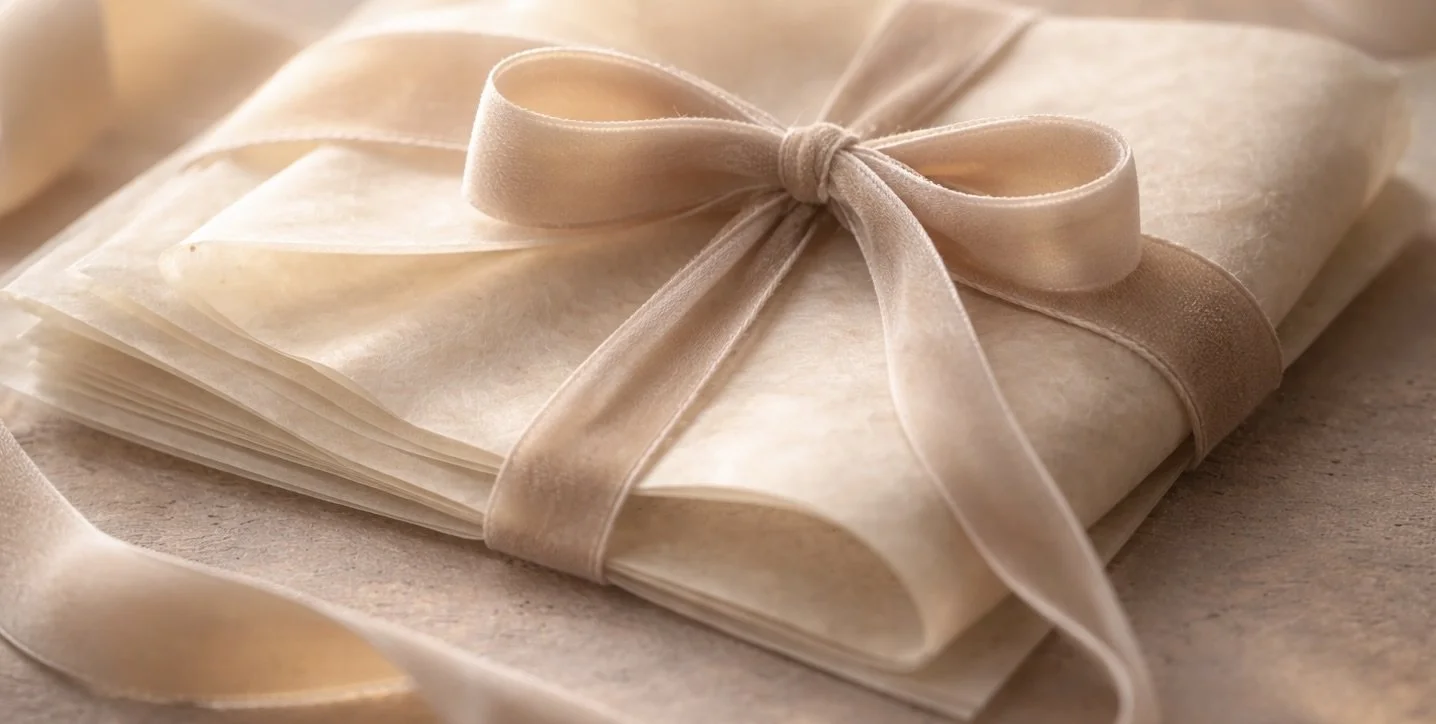
There was a day in my not-so-distant past when parcels were elegantly folded into the softest pastel tissue and nested carefully in a box. The experience mattered. The handling mattered.
This valuing — not only of the thing,
but of the name written on the card,
the relationship it represented,
the love it carried —
this is what rises in me now.
Instead of becoming overtly exasperated, instead of allowing irritation to set the tone of the moment, I inhaled deeply and take the sweater back into my hands.
“Here,” I say gently. “Let me show you.”
Aware of the line forming behind me, I asked for a sheet or two of tissue. I laid my mama’s gift flat upon the counter and envelope it like a fragile infant — folding left, folding right — carefully, deliberately, with attention.
There are no words needed to make a point, because a point is not what is being made.
This is something older than instruction.
A belief formed over time: that how we move through a moment matters as much as the moment itself.
In the midst of this Season, I wonder briefly if that young girl remembers our encounter — the cashmere sweater, the tissue, the slowness. Whether it registered at all.
But the wondering doesn’t linger. Because it was never about the moment, but the practice of grace given in and through even the little things.
The agenda I carry — the list of things waiting — doesn’t disappear. It rarely does. But beneath it, another list continues to assert itself, quieter but more essential:
Remember to breathe.
Extend patience.
Smile and engage.
This is the work I return to — not once, but repeatedly.
To go against the flow.
To resist the urge to simply “get through” the day.
To live as soft parchment, folding each encounter gently into what comes next — precisely, carefully — allowing no part of the day to be handled roughly.
What is precious, in the end, is not the thing in our hands, but the awareness we bring to holding it. The choice to arrive fully before allowing the weight of everything else to press in.
There is no guarantee that I will bring my best self into a moment.
There is only the decision to intend it.
And so the practice continues —
not in grand gestures,
not in moments that announce their importance,
but in the ordinary exchanges that make up a life.
How we fold.
How we move from one moment into the next.
How we handle with care.
NOTES
I was a little girl growing up with a daddy who was a Neiman Marcus VP.
This is the lens that shaped my understanding of care long before I knew to name it.
I remember the children’s department at Christmas most vividly — to get there, we boarded a special elevator lined in red velvet. To leave, we perched atop a satin cushion and rode a giant slide all the way down.
If reading this fills you with wonder, imagine how those who created the experience must have felt. Isn’t it true that what we bring to any situation is far more spiritually and emotionally filling than what we take?
Neiman Marcus taught me something quietly and early — not about excess, but about imagination. What the store practiced so beautifully was not simply elaborate gift-giving, but an extravagant attentiveness: the art of seeing someone clearly and responding with care.
That same generosity of spirit isn’t seasonal, and it isn’t dependent on money. It’s a posture the heart takes on any day of the year — in how we listen, how we prepare, how we handle what’s been entrusted to us.
We may not all be gifted to that degree.
But most of us can tie a simple, lovely bow.
This is the care I want to fold into my days.
Not excess, but intention.
Not perfection, but presence.
Like a baby in a manger — unexpected, unadorned — the real treasure is often found away from the crowds, in the quiet places where attention to detail still lives—Janene